Author: Preston Ferguson

  • What an Editorial Intimate Session Actually Looks Like

    What an Editorial Intimate Session Actually Looks Like

    Subscribe to continue reading

    Subscribe to get access to the rest of this post and other subscriber-only content.

  • How Better Photos Changed the Way a Queenstown Holiday Home Sells Itself

    How Better Photos Changed the Way a Queenstown Holiday Home Sells Itself

    I usually travel to make photographs of places. On this trip, I ended up making them for a business, too — and it turned into the clearest example I have of why hospitality photography actually matters.

    The setup

    We stayed at a holiday home in Queenstown, New Zealand called The Wanderlust, run by Arrowtown Holiday Homes. It’s the kind of property that has real character — the sort of place a great photo can sell in a single scroll, and a bad one can quietly bury. While we were there, I photographed it: not just “here are the rooms,” but the mood of the place — the light it gets, how it actually feels to be there.

    Why it matters (the part every host should hear)

    A guest experiences your property online long before they ever step through the door. They’re not reading your description first — they’re scrolling your photos, and deciding in about two seconds whether this is the place. Professional images don’t just make a listing prettier; they set the expectation, build the trust, and win the booking before anyone’s packed a bag.

    The result — in the owner’s words

    “Preston took photos for us in Queenstown, New Zealand. The images are absolutely stunning! They capture the mood and personality of the property so beautifully… It can be tricky finding a photographer who really ‘gets’ the holiday home.”

    — Sarah, Arrowtown Holiday Homes

    The part I’m quietly proud of: they’ve kept using the photos — they still turn up on the property’s Instagram months later. That’s the real measure. Not a nice compliment on delivery day, but images that keep earning their keep in the marketing long after the shoot.

    The same thing, closer to home

    I do exactly this for short-term rentals and boutique properties around Salt Lake City and Utah — capturing the mood and personality that make a property book, not just a checklist of rooms. If your listing photos are doing the bare minimum, that’s a fixable problem.

    — Preston

    More on hospitality photography

  • How I Make an Intimate Set Feel Safe

    How I Make an Intimate Set Feel Safe

    Subscribe to continue reading

    Subscribe to get access to the rest of this post and other subscriber-only content.

  • A Photographer’s Guide to New Zealand’s South Island (Where to Point the Camera)

    A Photographer’s Guide to New Zealand’s South Island (Where to Point the Camera)

    We spent the better part of a week working our way across New Zealand’s South Island with the cameras out the entire time. Here’s the route we actually took, and — more useful for you — where the light genuinely earned its keep. Consider it the guide I wish I’d had, written by someone who was cold and standing in most of these spots.

    First, a warning.

    Getting in: the Queenstown airport will test your nerves

    Queenstown’s airport is tucked between mountains, and the wind has opinions. Our plane got within about fifty feet of the ground twice — once from each direction of the runway — aborted both times, and then simply gave up and flew us to Christchurch for the night. So: book a flexible fare, keep your expectations loose, and maybe have a Christchurch dinner spot in your back pocket. (Ours was Kaiser Brew Garden in Riverside Market. You’re welcome.)

    Queenstown & Arrowtown — your base

    Queenstown is the hub. Ride the Skyline gondola up at dusk for the town-and-lake view (the go-karts at the top are non-negotiable, for research purposes). Then give Arrowtown a full slow day — rent bikes and ride out through the countryside to the wineries. If you can time it for autumn color, do; the whole valley turns.

    Milford Sound — go even if it’s raining. Especially if it’s raining.

    We were supposed to fly back from Milford and got rained out, so we bused. Best accident of the trip: the rain turns the cliff faces into hundreds of temporary waterfalls you’d never see on a clear day. Take the boat. Get soaked. Worth it.

    Blue Pools & Haast Pass — glacial blue, and then some

    The Blue Pools are an easy, gorgeous stop — that impossible glacial color. And if you’re willing to get cold and a little lost past Haast Pass, there’s more back there than the pull-offs suggest. (That one turned into its own story.)

    The Wanaka Tree & Lake Pukaki — the postcard blues

    The lone Wanaka Tree is the most photographed tree in the country, so shoot it at first light or blue hour unless you enjoy other people’s tripods in your frame. Just up the road, Lake Pukaki’s glacial blue barely looks real; a roadside viewpoint does the whole job.

    Mt John Observatory & Lake Tekapo — save the overcast day for this

    Climb to the Mt John observatory for the big-sky view over Tekapo (ours was a last-minute call and immediately worth it). Down on the lakeshore is the Church of the Good Shepherd — a tiny stone church against all that openness. An overcast sky is a gift here, not a setback.

    The train + the ferry — shoot the coast, watch the weather

    The Christchurch → Picton train (spring for first class; you’ll be wined and dined past open-air coastal views) hands you the South Island’s coastline on a plate. Then the ferry across the Cook Strait to the North Island — smooth for us, and the last one to make it across for a couple of days as the weather turned. Check the forecast, and don’t dawdle.

    The prints

    A lot of these stops came home as photographs, and several are becoming prints in the shop. If you’re just starting a wall, start with a postcard. That’s how every collection starts.

    — Preston

  • The Church of the Good Shepherd: New Zealand at the End of the Earth

    The Church of the Good Shepherd: New Zealand at the End of the Earth

    I didn’t plan this one. Which, if you ask me, is usually when the good ones happen.

    We’d been photographing our way toward Christchurch — the lone Wanaka Tree standing out in the lake like it knows it’s being watched, the impossible glacial blue of Lake Pukaki, a last-minute detour up to the Mt John observatory because someone (me) couldn’t help himself. We stopped for lunch by Lake Tekapo. And there, right on the shore, was this little stone church.

    The Postcards Collection – New Zealand Lake Tekapo Fig 1 – Framed Print

    383be92f-2afe-4458-81f9-2e183e948490

    The Church of the Good Shepherd has stood on that spot since 1935 — which is to say, longer than anyone I thought to ask. It’s small. It’s plain. And on the day we were there it was flatly, gloriously overcast: the kind of grey light photographers pretend to be annoyed by and secretly adore, because it turns the entire sky into one enormous softbox.

    I set the lake in front of it, the mountains behind it, and the little church in the middle of all that openness — and I knew before I’d taken the frame that it was the one. It’s the whole New Zealand experience in a single picture: just enough man-made to feel like home, sitting right on the doorstep of the wild.

    What New Zealand actually feels like

    Raw, untouched beauty is the closest I can get. It feels like the end of the earth — hostile enough to keep you honest, cold enough to remind you you’re a guest, and beautiful in a way that, somehow, no one has managed to wreck yet.

    (I also came home with an indefensible number of photos of highland cows. New Zealand has the best-dressed livestock on the planet, and I will not be taking questions.)

    A shaggy highland cow with a long fringe over its eyes, standing in a green New Zealand pasture.
    Exhibit A. I rest my case.

    The postcard

    The church became part of the Postcards Collection — with a print for the wall, if a small church at the end of the earth earns a bigger spot in your house than a postcard rack. Start with the postcard. That’s how every collection starts.

    — Preston

  • Greetings From Sydney: The Opera House Detail You Never See

    Greetings From Sydney: The Opera House Detail You Never See

    We got up before the sun to photograph a building that is, by most counts, one of the most photographed on earth. Which, when I say it out loud, sounds like a bad plan.

    Matt and I walked over to Mrs Macquarie’s Chair in the dark — a little cold, mostly quiet. There was a crow and a pigeon having what I can only describe as a strong disagreement, and one other couple further out toward the point who had very clearly not come for the architecture. And then there was the Opera House, waiting to catch the first light.

    Here’s the thing about the Opera House: we’ve all seen it. The whole white sweep of it, sails and all — from the ferry, from the bridge, from every postcard rack in New South Wales. And because we’ve seen the whole thing so many times, we’ve quietly stopped seeing the parts. Up close, those sails aren’t smooth at all. They’re clad in more than a million tiles in this restrained little chevron pattern, and almost every photo flattens the whole thing into one white blur.

    So that’s what I went for. Not the building — the skin of it. The tile detail up top, catching the very first light, set against the kind of deep blue you only get for about twenty minutes before the day turns ordinary.

    The Postcards Collection – Sydney Opera House – Framed Print

    04db2c7e-b223-43ab-8b26-2fcdc5c6581c

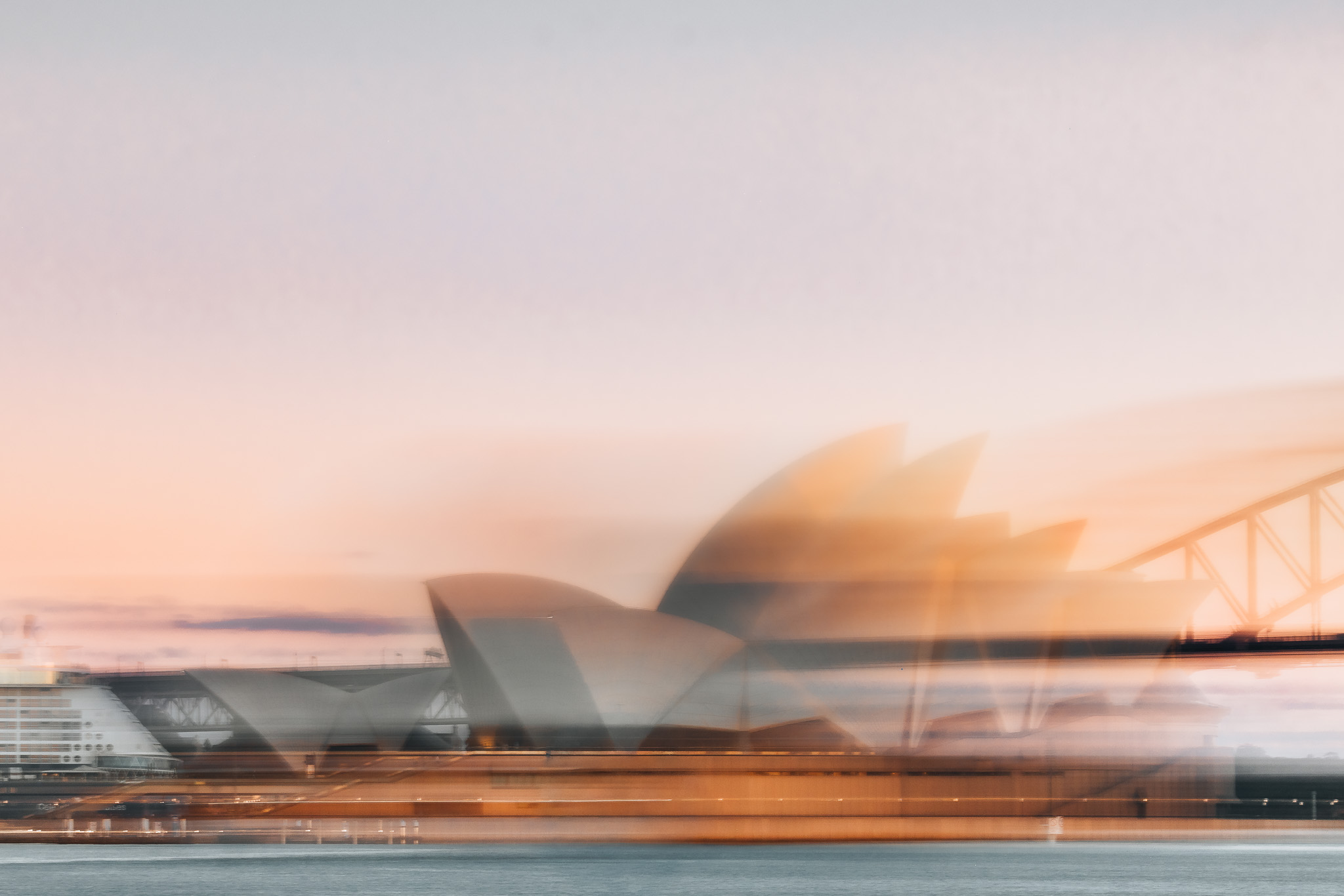
    (I also spent a few frames doing something stranger — dragging the camera through a long exposure to smear the whole thing into motion. That one’s not in the shop yet. But since you’re here:)

    Intentional-camera-movement long exposure of the Sydney Opera House at dawn, the white sails smeared into vertical streaks of motion against a deep blue sky.
    The “drag” frame — same building, same morning, held the shutter open and let it move.

    A quick, honest tangent

    We’d just come through a couple of trips in Asia, and Sydney hit different. It felt so Western — so familiar — that it shrank the world for a minute. A massive, buzzing city on the far side of the planet that somehow felt like it could be home. I’ll also admit that by the time we made it to New Zealand and there was finally some open space and nobody around, I was relieved. You can love a city and still be glad to leave it.

    The postcard

    Greetings from Sydney — Vintage Travel Postcard (Pack of 10)

    The detail shot became Greetings From Sydney in the Postcards Collection — in case you want to drop a cheeky note to a friend or you’re leaning more into creating a collage by framing it.

    — Preston

  • From First Purchase to Curated Collection: Your Roadmap

    From First Purchase to Curated Collection: Your Roadmap

    Every collection starts the same way. With one piece.

    Not a perfectly planned vision.
    Not a fully formed aesthetic.

    Just something that felt right at the time. And if you’re early in the process, it can be hard to see how that one decision turns into something more cohesive. But it does.

    You just don’t build it all at once.


    Step 1: Start With a Single Piece That Connects

    Your first purchase sets the tone—but it doesn’t define everything that comes after. It just needs to be something you genuinely connect with.

    Not something that matches your space perfectly. Not something you think you should like. Just something you want to live with.

    If you’ve followed along from the beginning, this should feel familiar. Because the foundation of any collection is simple: Connection first.


    Step 2: Pay Attention to What You’re Drawn To

    After that first piece, something interesting happens. You start to notice patterns.

    Certain tones.
    Certain compositions.
    Certain environments or moods.

    That’s your taste becoming more defined. Not forced. Not curated yet. Just revealed.


    Step 3: Add With Intention, Not Urgency

    This is where most people go off track. They try to “complete” a collection too quickly. But strong collections aren’t built fast.

    They’re built thoughtfully. Each addition should feel like it belongs—not because it matches perfectly, but because it resonates in the same way your first piece did. That takes time. And that’s a good thing.


    Step 4: Think in Relationships, Not Just Individual Pieces

    At a certain point, you stop seeing each piece in isolation. You start seeing how they work together.

    How one image balances another.
    How tones and textures interact.
    How spacing and scale create rhythm.

    This is where a collection starts to feel curated. Not because everything is identical. But because everything feels connected.


    Step 5: Refine Over Time

    A collection isn’t static. It evolves.

    You may rearrange pieces. Upgrade presentation. Add something that shifts the entire dynamic.

    That’s part of the process. And it’s what keeps collecting interesting.


    How This Brings Everything Together

    In the previous post—The Art of Display: Why Presentation Affects Perceived Value—we talked about how placement and presentation shape how work is experienced.

    This is the full picture. Because collecting isn’t just about choosing individual pieces. It’s about building something over time—something that reflects your taste, your environment, and how you want your space to feel.


    A Simple Way to Think About It

    You don’t need a perfect plan.

    You need a starting point.

    And the willingness to keep going.


    Final Thought

    No one builds a great collection overnight. They build it piece by piece—by paying attention to what resonates, and trusting that over time, it will come together.

    And it does.

    If you’re ready to start (or continue) building your collection, explore the current selection of limited edition prints and find the next piece that moves you forward.

    Browse Available Limited Edition Prints

  • The Art of Display: Why Presentation Affects Perceived Value

    The Art of Display: Why Presentation Affects Perceived Value

    Two people can own the exact same print.

    Same image.
    Same size.
    Same paper.

    And yet, one feels like a statement piece… while the other feels like an afterthought. The difference isn’t the artwork. It’s the presentation.


    Why Presentation Changes Everything

    Art doesn’t exist in isolation. It lives in a space. And the way it’s displayed directly affects how it’s perceived—not just by others, but by you.

    A well-presented piece feels intentional. Considered. Finished.

    Poor presentation does the opposite. It flattens the impact.


    Framing Is Not Just Protection

    A lot of people treat framing as an afterthought. Something you do after the fact, just to get it on the wall. But framing is part of the experience. It defines how the piece is seen:

    • The spacing
    • The border
    • The materials
    • The way light interacts with the surface

    A strong frame doesn’t compete with the work—it elevates it.


    Environment Matters More Than You Think

    Where you place a piece changes how it reads. Lighting, surrounding elements, and even wall color all play a role. A print placed thoughtfully becomes a focal point.

    The same print placed randomly becomes background. That difference has nothing to do with the image—and everything to do with context.


    How This Connects to What You’ve Learned

    In the previous post—Why Some Collectors Only Buy From Direct Artists—we talked about connection to the source.

    This is where that connection continues. Because once you’ve chosen a piece intentionally, how you present it is the next layer of that intention.

    It’s the difference between owning something… and actually showcasing it.


    Why This Impacts Perceived Value

    Perceived value isn’t just about price or rarity. It’s about how something feels in its environment. A well-presented piece:

    • Commands attention
    • Feels more substantial
    • Holds its presence over time

    Even the same artwork can feel more “valuable” simply because it’s displayed with care. That’s not illusion. That’s experience.


    A Simple Way to Think About It

    Buying the artwork is only half the process.

    Displaying it is the other half. And the second half is what people actually see every day.


    Final Thought

    A great piece of art deserves more than just a place on the wall. It deserves to be presented in a way that reflects why you chose it in the first place.

    Because when presentation is done right, the work doesn’t just sit in your space. It defines it.

    If you’re ready to bring something into your space that’s worth displaying well, explore the current collection of limited edition prints and find the piece that deserves to be the focal point.

    Browse Available Limited Edition Prints

  • Why Some Collectors Only Buy From Direct Artists

    At some point, collectors start to notice something. They’re not just choosing what to buy. They’re choosing who to buy from.

    And for a growing number of collectors, that choice becomes intentional: They prefer to buy directly from the artist.


    What Changes Over Time

    When you first start collecting, the process is simple. You find something you like. You buy it.

    Where it comes from doesn’t feel all that important. But as your understanding deepens, that starts to shift. Because you begin to realize that the source of the work shapes the experience just as much as the work itself.


    A More Direct Connection

    Buying directly from an artist removes distance. You’re not going through layers of curation, markup, or interpretation. You’re seeing the work as it was intended to be presented.

    And more importantly—you know exactly where it came from. That connection adds something subtle, but real. It makes the piece feel more personal. More grounded. More complete.


    Clarity Around the Work

    When you buy direct, there’s less ambiguity.

    You know:

    • How the work is produced
    • What materials are being used
    • How editions are structured
    • What the artist intended

    There’s no guesswork. And that clarity becomes more valuable as you start to care about details like quality and longevity.


    How This Connects to Value

    In the previous post—Why Emerging Artists Can Be the Smartest Investment—we talked about recognizing strong work early.

    Buying direct is often how that happens. Because you’re not waiting for a gallery or market to validate the artist first. You’re seeing the work in its earliest, most accessible stage—and deciding for yourself.


    A Different Kind of Experience

    This isn’t about saying one approach is better than another. Galleries have their place. So do secondary markets. But buying direct offers something different.

    It’s closer to the source. More transparent. And often, more aligned with how the work was meant to be experienced.


    A Simple Way to Think About It

    Buying through a third party is like being introduced to the work. Buying direct is like being part of it.


    Final Thought

    As you spend more time collecting, you start to value more than just the image.

    You start to value the process. The intention. The connection to where it came from.

    And for many collectors, that naturally leads them closer to the artist.

    If you’re ready to collect work at the source, explore the current selection of limited edition prints and experience what it means to buy directly from the artist who created them.

    Browse Available Limited Edition Prints

  • Why Emerging Artists Can Be the Smartest Investment

    Why Emerging Artists Can Be the Smartest Investment

    When people talk about investing in art, the conversation usually centers around established names. Recognizable. Proven. Safe. And while there’s nothing wrong with that approach, it often comes with one tradeoff:

    You’re arriving late.


    Where the Real Opportunity Tends to Be

    The most interesting collections aren’t built by following the crowd. They’re built by paying attention early.

    Because before an artist becomes widely recognized, there’s a window—sometimes short, sometimes longer—where their work is still accessible. Not just financially, but personally. You’re not competing with everyone else yet.

    You’re discovering.


    Why Emerging Artists Matter

    Emerging artists are still in the process of defining their voice. Refining their style. Expanding their body of work.

    And that evolution is part of what makes collecting at this stage compelling.

    You’re not just buying a finished legacy. You’re stepping into a trajectory.


    The Investment Side (Without the Hype)

    Let’s be clear—this isn’t a guarantee of financial return. Most emerging artists won’t suddenly skyrocket in value.

    But some will. And when that happens, the earliest collectors are the ones who benefit the most. Not because they timed a market perfectly—but because they recognized something early and acted on it.


    How This Connects to What You’ve Learned

    In the previous post—Are Photography Prints a Good Investment? Let’s Be Honest—we talked about how value in art is often misunderstood. This is where that idea becomes more practical.

    Because if you’re looking for upside potential, it rarely comes from buying what’s already widely recognized. It comes from identifying work that feels strong before everyone else agrees.


    What to Look For in an Emerging Artist

    Not hype. Not follower count. Consistency.

    Look for:

    • A clear visual voice
    • A growing, cohesive body of work
    • Attention to quality and presentation
    • A sense that the work is evolving, not repeating

    These are the signals that tend to hold up over time.


    A Better Way to Think About It

    Instead of asking: “Is this artist already successful?”

    Ask: “Does this work feel like it’s going somewhere?”

    Because that question shifts your focus from popularity to potential. And that’s where the opportunity lives.


    Final Thought

    Collecting emerging artists isn’t about chasing upside. It’s about recognizing something early—and choosing to be part of it. Because the most meaningful collections aren’t built all at once. They’re built over time, piece by piece, as your eye sharpens and your taste evolves.

    If you’re ready to start collecting work that feels like it’s on the rise, explore the current selection of limited edition prints and find the piece that stands out before everyone else catches on.

    Browse Available Limited Edition Prints