
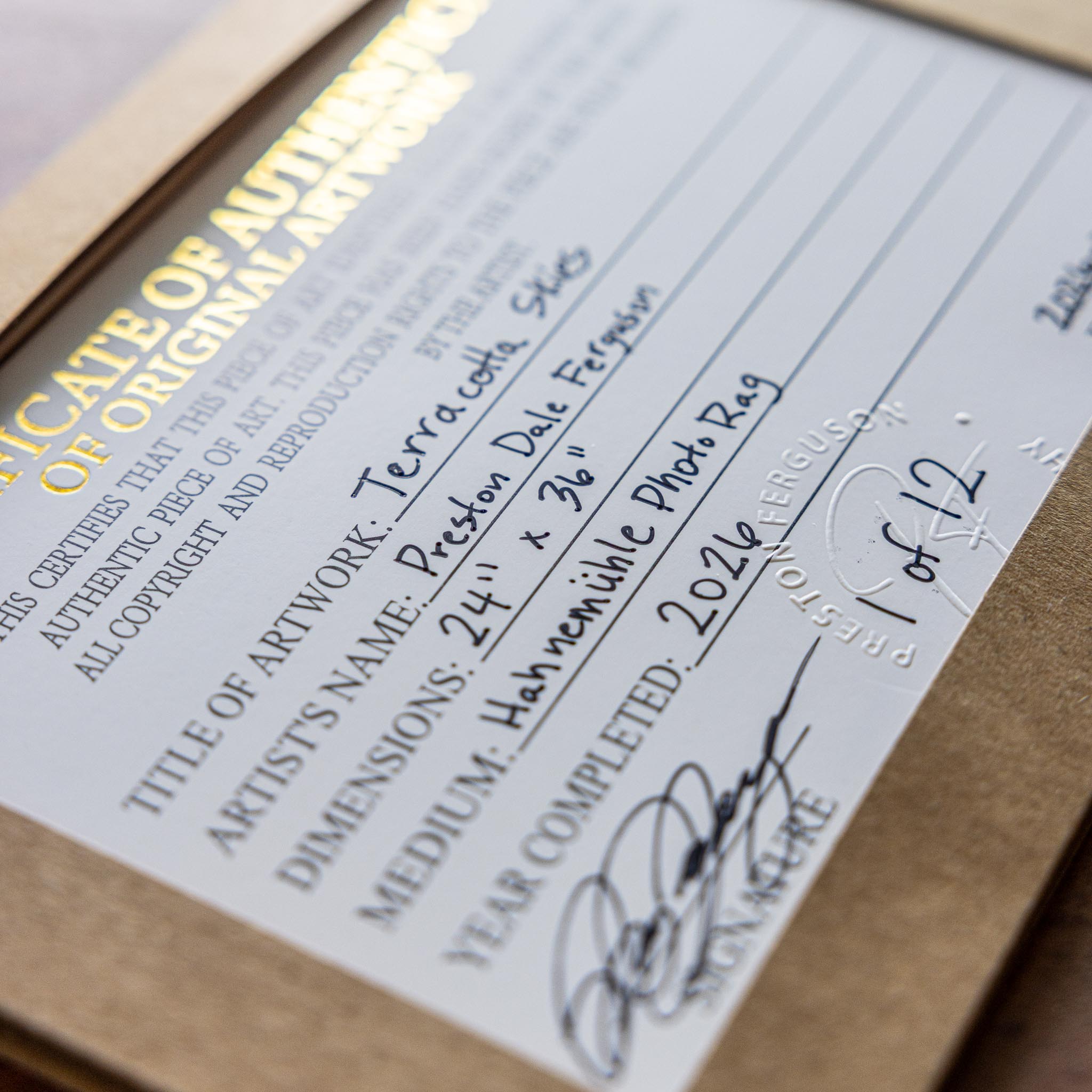
If you’re purchasing a limited edition photograph, you’re not just buying paper and ink. You’re acquiring a documented piece of an archive. And that documentation matters.
A Certificate of Authenticity (often called a COA) is not decorative paperwork. It is a record of legitimacy.
If you care about long-term value, provenance, and credibility, you should care about this document.
What Is a Certificate of Authenticity?
A Certificate of Authenticity is a signed document issued by the artist (or studio) that verifies:
- The artwork is genuine
- The edition size
- The specific print number
- The title of the work
- The year of release
- The materials used
- The artist’s signature
It confirms that the piece you own is part of a legitimate, controlled edition. Without it, proof becomes weaker over time.
Authenticity: Why It’s Not Optional
In photography, duplication is easy. Files can be copied. Images can be reprinted.
That’s why structure matters. A COA confirms that:
- This specific print was produced under the artist’s supervision
- It belongs to a declared limited edition
- It was not reproduced outside that structure
It draws a line between authorized and unauthorized production. For serious collectors, that line is essential.
Provenance: The Story of Ownership
Provenance refers to the documented history of an artwork’s ownership. Over time, provenance builds through:
- Certificates
- Receipts
- Exhibition records
- Private sales documentation
If artwork is ever resold or transferred, provenance strengthens credibility. Without documentation, questions arise.
Decades from now, when a print changes hands, the COA becomes evidence. It protects both the artwork and the collector.
Edition Tracking: Structural Integrity
In limited edition photography, tracking is critical.
Each print has:
- A number (for example, 7/25)
- A total edition size
- A permanent closure once sold out
A Certificate of Authenticity confirms that:
- The edition size was declared in advance
- The specific print number exists within that edition
- The artist has not exceeded the stated limit
Collectors rely on this discipline. If edition tracking is inconsistent, scarcity becomes meaningless. Documentation reinforces restraint.
Long-Term Credibility
Most people don’t think 20 or 30 years ahead when purchasing art. But credibility compounds over time.
When collectors, galleries, or estates evaluate a work years later, they look for:
- Original documentation
- Consistent edition policies
- Clear artist signatures
- Archival production details
The more complete the documentation, the stronger the work’s standing. A well-documented archive ages better than a loosely managed one.
How My Certificates Work
Each limited edition print I release includes:
- The title of the work
- The year of release
- The edition size
- The individual print number
- Archival material details
- My signature
The edition size is declared in advance and does not change. Once the edition sells out, it closes permanently.
The certificate corresponds directly to that edition — and exists to protect its integrity.
I do not reissue sold-out editions.
I do not expand edition sizes later.
I do not reproduce the same format once closed.
The certificate reflects that discipline.
Why Documentation Matters Decades Later
Paper fades. Digital platforms disappear. Websites evolve.
But physical documentation persists.
If a collector chooses to resell, donate, or pass work to the next generation, documentation supports legitimacy. Without it, questions arise:
- Was this part of a declared edition?
- Was the edition exceeded?
- Was it printed under the artist’s supervision?
Clear documentation removes uncertainty. And uncertainty weakens value.
Decorative Prints vs Documented Works
Again, this is not about superiority — it’s about structure. Decorative prints often do not include formal documentation because:
- They are not edition-controlled
- They are reproducible
- Scarcity is not a factor
Collectible works include documentation because permanence matters. A Certificate of Authenticity signals that the work was created and released with long-term intention.
Final Thought
A Certificate of Authenticity is not just paperwork.
It is a promise. A promise that:
- The edition size is real
- The print is genuine
- The archive is disciplined
- The collector is protected
If you’re beginning to collect fine art photography, ask about documentation. Clarity today protects confidence tomorrow.
If you’d like to explore my current limited releases — each accompanied by a signed Certificate of Authenticity — you can view available editions here.
Collect thoughtfully. Document carefully.
Featured limited editions
A curated selection of landscapes available in limited quantities. Visit the shop for current availability, sizes, and framing options.
-

Canyons Gaze – Signed Limited Edition Print + Certificate
Price range: $375.00 through $2,800.00 -

Lunar Descent – Signed Limited Edition Print + Certificate
Price range: $525.00 through $3,300.00 -

Still Rising – Signed Limited Edition Print + Certificate
Price range: $375.00 through $2,800.00 -

The Quiet at Fushimi – Signed Limited Edition Print + Certificate
Price range: $525.00 through $3,300.00