Tag: Provenance

Authenticity and the record of a work — signatures, certificates, and edition history.

  • Why Some Collectors Only Buy From Direct Artists

    At some point, collectors start to notice something. They’re not just choosing what to buy. They’re choosing who to buy from.

    And for a growing number of collectors, that choice becomes intentional: They prefer to buy directly from the artist.


    What Changes Over Time

    When you first start collecting, the process is simple. You find something you like. You buy it.

    Where it comes from doesn’t feel all that important. But as your understanding deepens, that starts to shift. Because you begin to realize that the source of the work shapes the experience just as much as the work itself.


    A More Direct Connection

    Buying directly from an artist removes distance. You’re not going through layers of curation, markup, or interpretation. You’re seeing the work as it was intended to be presented.

    And more importantly—you know exactly where it came from. That connection adds something subtle, but real. It makes the piece feel more personal. More grounded. More complete.


    Clarity Around the Work

    When you buy direct, there’s less ambiguity.

    You know:

    • How the work is produced
    • What materials are being used
    • How editions are structured
    • What the artist intended

    There’s no guesswork. And that clarity becomes more valuable as you start to care about details like quality and longevity.


    How This Connects to Value

    In the previous post—Why Emerging Artists Can Be the Smartest Investment—we talked about recognizing strong work early.

    Buying direct is often how that happens. Because you’re not waiting for a gallery or market to validate the artist first. You’re seeing the work in its earliest, most accessible stage—and deciding for yourself.


    A Different Kind of Experience

    This isn’t about saying one approach is better than another. Galleries have their place. So do secondary markets. But buying direct offers something different.

    It’s closer to the source. More transparent. And often, more aligned with how the work was meant to be experienced.


    A Simple Way to Think About It

    Buying through a third party is like being introduced to the work. Buying direct is like being part of it.


    Final Thought

    As you spend more time collecting, you start to value more than just the image.

    You start to value the process. The intention. The connection to where it came from.

    And for many collectors, that naturally leads them closer to the artist.

    If you’re ready to collect work at the source, explore the current selection of limited edition prints and experience what it means to buy directly from the artist who created them.
    Browse Available Limited Edition Prints

  • The Truth About Signed vs. Unsigned Prints

    The Truth About Signed vs. Unsigned Prints

    At some point, every new collector runs into the question:

    “Does it really matter if a print is signed?”

    And like most things in the art world, the answers tend to be… unclear. Some will say it’s essential. Others will say it doesn’t matter at all. The truth sits somewhere in the middle—but once you understand it, your approach to collecting starts to shift.


    What a Signature Actually Represents

    A signature isn’t just a name written on paper. It’s a signal.

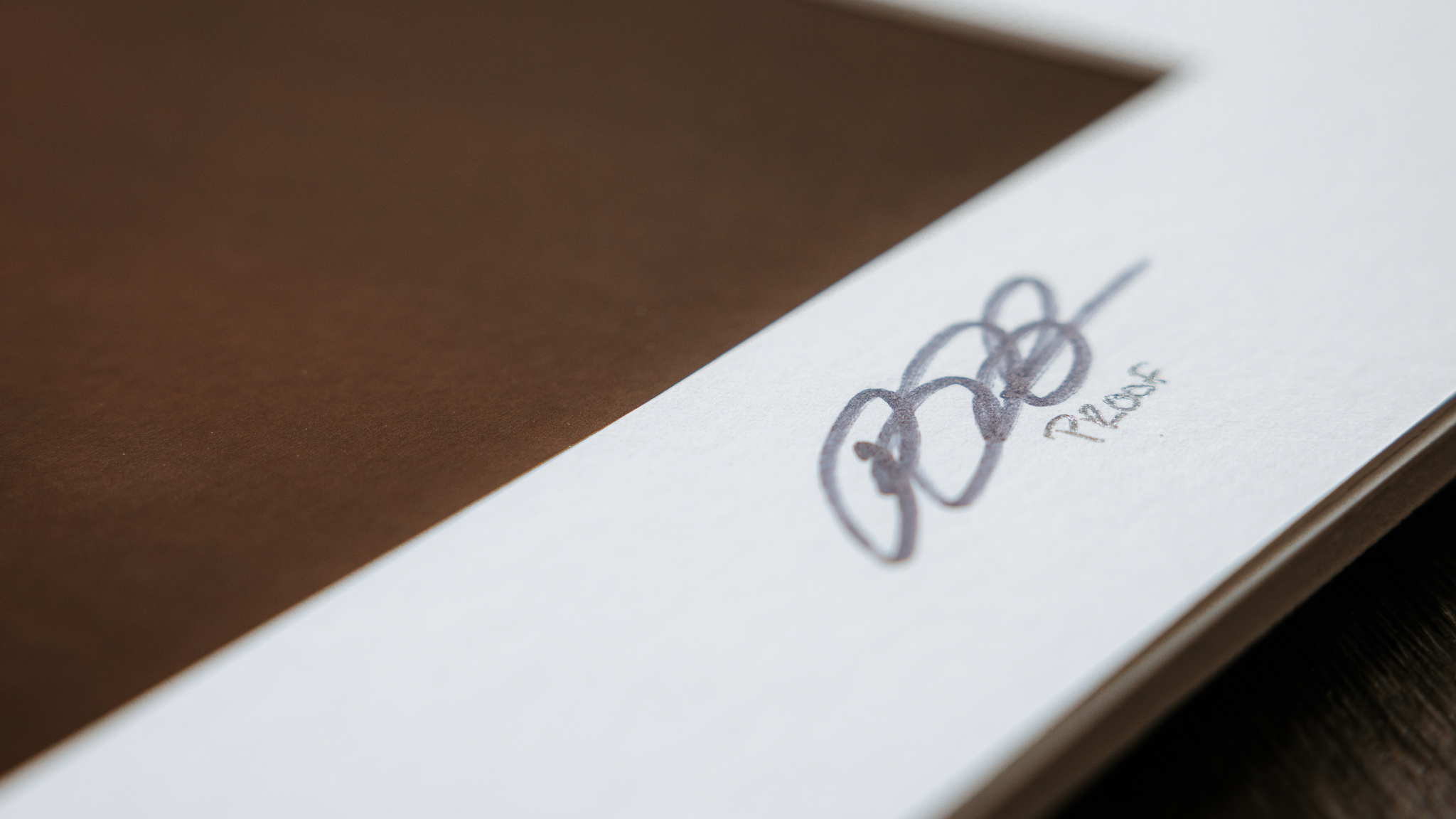
    It tells you the artist has personally approved that specific print as part of their body of work. That it’s not just a reproduction—it’s intentional. In many cases, it’s also tied to a limited edition. A defined number of prints that will ever exist in that format.

    That combination—intentionality and scarcity—is what gives a signed print its weight.


    Why Collectors Care (Even If They Don’t Say It Out Loud)

    When collectors choose signed work, they’re not just thinking about how it looks on the wall.

    They’re thinking about:

    • Authenticity
    • Scarcity
    • Connection to the artist

    A signed print feels closer to the source. More complete. More final. It’s the difference between owning an image… and owning a piece of the artist’s work.


    So Are Unsigned Prints “Less Valuable”?

    Not necessarily. Unsigned prints can still be:

    • High quality
    • Visually striking
    • Worth owning

    But they typically live in a different category. They’re often open editions, meaning they can be produced without a strict limit. That doesn’t make them bad—it just means they don’t carry the same built-in scarcity.

    And in art, scarcity plays a bigger role than most people expect.


    Where This Connects to How You Choose Art

    If you read the previous post—The #1 Mistake New Art Collectors Make (And How to Avoid It)—you know the biggest trap is overthinking and trying to choose what you’re supposed to like. This is where that idea evolves. Because once you’ve found a piece you genuinely connect with, the next step isn’t second-guessing your taste—it’s understanding what you’re actually buying.

    And that’s where details like signatures begin to matter.

    Not as decoration.

    But as definition.


    A Practical Way to Think About It

    If you’re buying purely for decoration, an unsigned print might be all you need. But if you’re starting a collection—something intentional, something that grows over time—signed, limited edition prints are where most collectors naturally gravitate. Not because they’re told to.

    Because they begin to understand the difference.


    Final Thought

    A signature isn’t about ink on paper. It’s about intention, authorship, and knowing that what you’re holding is part of a defined body of work. And once you see that difference, it changes how you collect.

    If you’re ready to move beyond decoration and start collecting with intention, explore the current selection of signed, limited edition prints and find the piece that feels like it was made to be yours.

    Browse Available Limited Edition Prints

  • What Is a Certificate of Authenticity — And Why It Matters

    What Is a Certificate of Authenticity — And Why It Matters

    If you’re purchasing a limited edition photograph, you’re not just buying paper and ink. You’re acquiring a documented piece of an archive. And that documentation matters.

    A Certificate of Authenticity (often called a COA) is not decorative paperwork. It is a record of legitimacy.

    If you care about long-term value, provenance, and credibility, you should care about this document.

    What Is a Certificate of Authenticity?

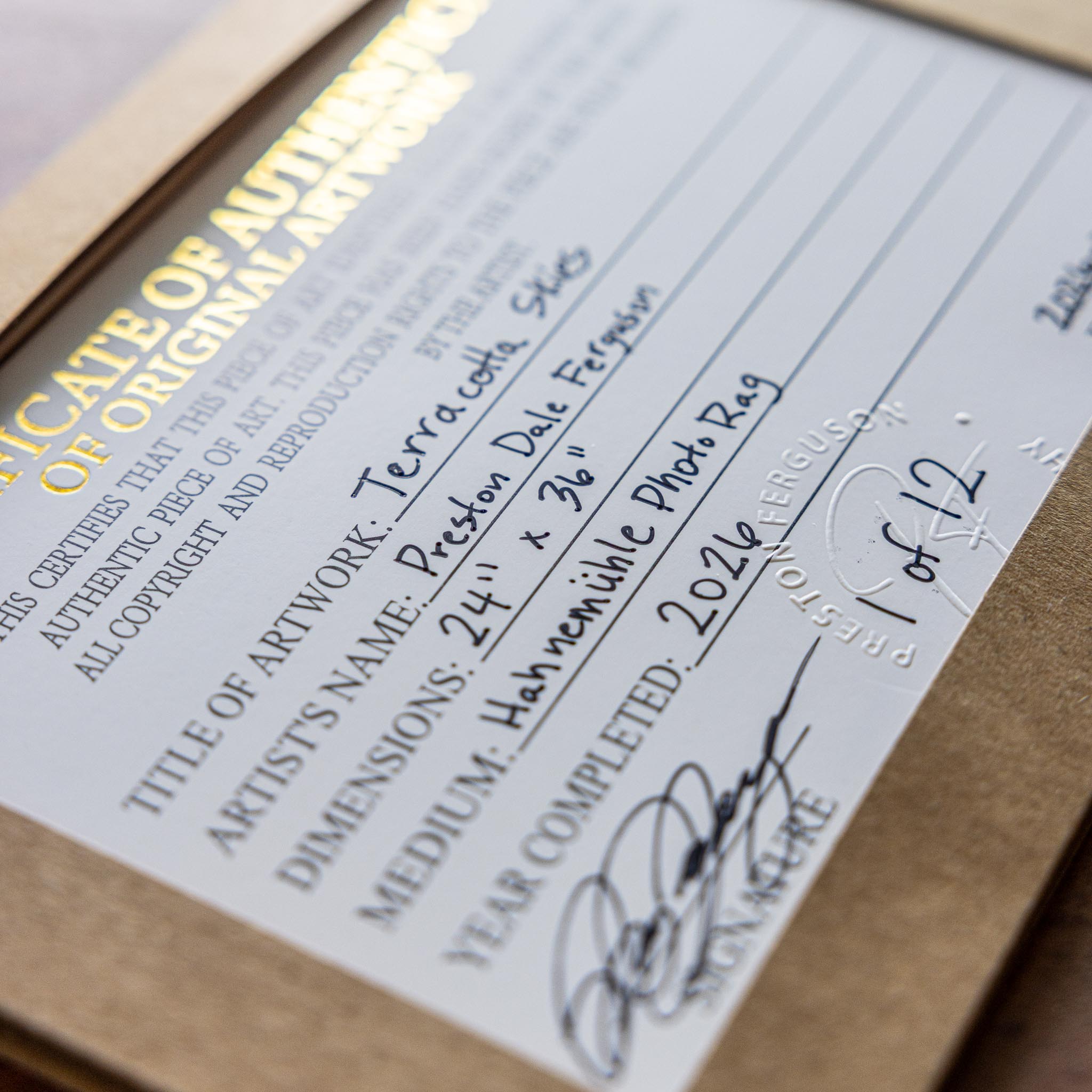
    A Certificate of Authenticity is a signed document issued by the artist (or studio) that verifies:

    • The artwork is genuine
    • The edition size
    • The specific print number
    • The title of the work
    • The year of release
    • The materials used
    • The artist’s signature

    It confirms that the piece you own is part of a legitimate, controlled edition. Without it, proof becomes weaker over time.

    Authenticity: Why It’s Not Optional

    In photography, duplication is easy. Files can be copied. Images can be reprinted.

    That’s why structure matters. A COA confirms that:

    • This specific print was produced under the artist’s supervision
    • It belongs to a declared limited edition
    • It was not reproduced outside that structure

    It draws a line between authorized and unauthorized production. For serious collectors, that line is essential.

    Provenance: The Story of Ownership

    Provenance refers to the documented history of an artwork’s ownership. Over time, provenance builds through:

    • Certificates
    • Receipts
    • Exhibition records
    • Private sales documentation

    If artwork is ever resold or transferred, provenance strengthens credibility. Without documentation, questions arise.

    Decades from now, when a print changes hands, the COA becomes evidence. It protects both the artwork and the collector.

    Edition Tracking: Structural Integrity

    In limited edition photography, tracking is critical.

    Each print has:

    • A number (for example, 7/25)
    • A total edition size
    • A permanent closure once sold out

    A Certificate of Authenticity confirms that:

    • The edition size was declared in advance
    • The specific print number exists within that edition
    • The artist has not exceeded the stated limit

    Collectors rely on this discipline. If edition tracking is inconsistent, scarcity becomes meaningless. Documentation reinforces restraint.

    Long-Term Credibility

    Most people don’t think 20 or 30 years ahead when purchasing art. But credibility compounds over time.

    When collectors, galleries, or estates evaluate a work years later, they look for:

    • Original documentation
    • Consistent edition policies
    • Clear artist signatures
    • Archival production details

    The more complete the documentation, the stronger the work’s standing. A well-documented archive ages better than a loosely managed one.

    How My Certificates Work

    Each limited edition print I release includes:

    • The title of the work
    • The year of release
    • The edition size
    • The individual print number
    • Archival material details
    • My signature

    The edition size is declared in advance and does not change. Once the edition sells out, it closes permanently.

    The certificate corresponds directly to that edition — and exists to protect its integrity.

    I do not reissue sold-out editions.
    I do not expand edition sizes later.
    I do not reproduce the same format once closed.

    The certificate reflects that discipline.

    Why Documentation Matters Decades Later

    Paper fades. Digital platforms disappear. Websites evolve.

    But physical documentation persists.

    If a collector chooses to resell, donate, or pass work to the next generation, documentation supports legitimacy. Without it, questions arise:

    • Was this part of a declared edition?
    • Was the edition exceeded?
    • Was it printed under the artist’s supervision?

    Clear documentation removes uncertainty. And uncertainty weakens value.

    Decorative Prints vs Documented Works

    Again, this is not about superiority — it’s about structure. Decorative prints often do not include formal documentation because:

    • They are not edition-controlled
    • They are reproducible
    • Scarcity is not a factor

    Collectible works include documentation because permanence matters. A Certificate of Authenticity signals that the work was created and released with long-term intention.

    Final Thought

    A Certificate of Authenticity is not just paperwork.

    It is a promise. A promise that:

    • The edition size is real
    • The print is genuine
    • The archive is disciplined
    • The collector is protected

    If you’re beginning to collect fine art photography, ask about documentation. Clarity today protects confidence tomorrow.

    If you’d like to explore my current limited releases — each accompanied by a signed Certificate of Authenticity — you can view available editions here.

    Collect thoughtfully. Document carefully.

    Featured limited editions

    A curated selection of landscapes available in limited quantities. Visit the shop for current availability, sizes, and framing options.